Aït Kebbash
The ForgivenThe Aït Kebbash are a desert community associated with Tafal’aalt, a remote village whose men arrive at Azna to claim Driss’s body. Their insistence that David Henniger accompany them home transforms his guilt from a private burden into a social and religious obligation. The group is presented through encounters with outsiders, but it is not merely a force in David’s journey: its village, customs, and livelihood give the journey a destination and a human context beyond his wish to be forgiven.
Identity and Home
At the gate of Azna, the older man leading the delegation identifies himself as Abdellah Taheri, an Aït Kebbash man from Tafal’aalt, and says that he has come to collect his only son, Driss. He repeats his request until those inside respond. The men accompanying him are described as middle-aged, dressed in white and indigo, and speaking Tamazight. Their arrival is not a solitary father’s journey but a collective one: other men have travelled with Abdellah from the far south, and they remain present as the family’s claim is heard.
Tafal’aalt is described as a village of about one hundred people, beyond the fossil town of Alnif, near the Algerian border and the mountain called Jbel Issomour. It lies where the oasis is drying and the desert plain is advancing. The account places the Aït Kebbash at the edge of settled life, but also connects them to a specific landscape and economy. Their home is not an abstraction or a backdrop: David is being taken to the place from which Driss came, among the people who knew him as a son and neighbor.
The Claim at Azna
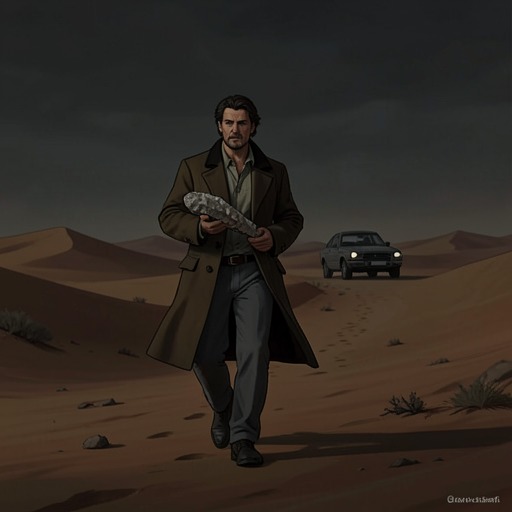
The Aït Kebbash delegation reaches Azna in a weathered vehicle after a long journey. Abdellah approaches the closed gate, kneels, and makes his request in a level voice, repeating it until the household reacts. Hamid recognizes the call and understands that the arrival is what he had anticipated. Richard initially treats opening the gate as an ordinary courtesy; Hamid cautions him that these visitors are Aït Kebbash and may seek money from him. Richard dismisses the warning, but the exchange establishes that the group’s presence carries weight within the household even before its purpose is fully addressed.
When the gate opens, Abdellah rises, brushes dust from his knees, and is admitted. The initial greetings are brief, and Hamid expresses sympathy before asking the dead boy’s name. Abdellah answers that Driss was his only son. This disclosure makes the purpose of the visit immediate and personal. The delegation’s repeated request is not presented as a negotiation over an unspecified debt: it begins with a father naming the child he has lost and asking to take him home.
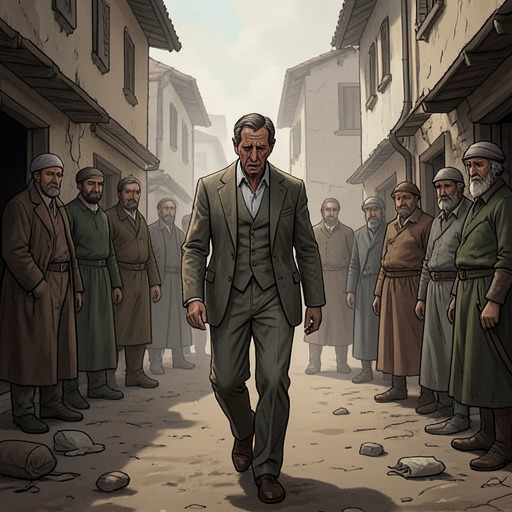
The Aït Kebbash also insist that David accompany them. Hamid tells David that the men are being polite, but are not simply asking whether he wishes to go; David will have little choice if they insist. David interprets their demand through suspicion, imagining extortion and a stereotyped “bandit mentality.” That judgement belongs to his anxious perspective, not to a confirmed account of the delegation’s intentions. He recognizes, however, that a financial handout would not do what the journey might: only Driss’s father and family could offer the forgiveness he wants. The Aït Kebbash thus confront him with a distinction between escaping official consequences and answering to the people affected by Driss’s death.
Journey, Custom, and Livelihood
The departure follows the urgency of burial. As David leaves with the delegation, the Aït Kebbash turn back to their vehicle; the narrative makes clear that a body must be buried without delay and that postponement violates their religious obligation. Jo gives David a long farewell kiss, but the men’s attention has shifted to the task ahead. Their actions place the burial custom above the formalities and emotions of the gathering: the dead must be taken home, and the journey cannot wait indefinitely.
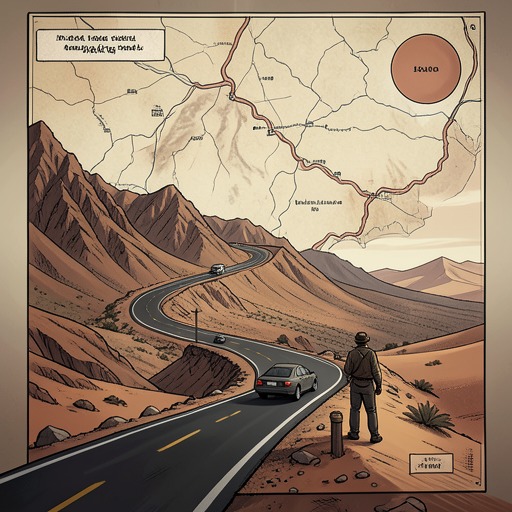
On the road, Abdellah drives while Anouar speaks with David. Anouar offers him a cigarette and explains that the party will travel straight through, with a stop in Erfoud to see people, drink, and rest. The group is shown not only as a silent delegation but as travellers sharing the practical work of a long drive. Their route passes through Errachidia and continues toward the fossil districts near Jbel Issomour. The journey connects the demand made at Azna to the actual distance and terrain separating David from Driss’s home.
Anouar also explains the Aït Kebbash’s particular place in the region’s fossil trade. The Aït Atta prospect for aquifers and crinoids, while the men of Tafal’aalt concentrate on trilobites. Anouar describes Jbel Issomour as a rich source and says that traders from Germany, France, and the United States pay substantial sums for Comura specimens, some selling for hundreds of euros. This account sets the community’s livelihood within a wider market: local extraction is tied to distant buyers, while different groups distinguish themselves through the resources they seek. Fossils are both products of the landscape and the means by which people in this remote region earn a living.
Arrival and Narrative Significance
At Mirzan quarry, David sees children with hammers and chisels near the work site, and one girl offers him a fossil, which he buys for a few dirhams. The scene briefly brings the region’s quarry economy into focus as lived work rather than Anouar’s account of trade. David is then kept away from Abdellah, who forbids him to come near. The restriction preserves the separation between the man seeking forgiveness and the bereaved father whose response he hopes to receive.
As the vehicle approaches Tafal’aalt, David sees a settlement of roughly two dozen domed homes, with gardens and date palms at the edge of the open desert. The metal doors bear blue trilobites. Abdellah hammers on one such door, and the women of the household emerge and run toward the car in lamentation. The arrival reveals what the delegation’s journey has been carrying: not simply a body to be buried, but a death that has entered a family and community. The Aït Kebbash give the novel’s movement toward atonement its concrete terms. David can travel with them and witness the bereavement he had previously held at a distance, but the evidence does not make the community’s eventual forgiveness automatic or reduce its grief to a means of his moral recovery.